Valikamam North: Land Disputes Persist Sixteen Years After Conflict’s End
Sixteen years after the conclusion of Sri Lanka’s armed conflict, Tamil residents of Valikamam North continue to face barriers to resettling on lands held under military occupation. Despite repeated government commitments, approximately 2,900 acres remain under security forces control within designated High Security Zones.
The persistence of these disputes reflects broader patterns of land appropriation that have characterised the Northern and Eastern provinces since 2009. By May 2009, HSZs in Jaffna had displaced over 65,000 people. The largest, the Tellipallai/Valikamam HSZ, covered 43 Grama Niladhari divisions. Progress in releasing these zones began in late 2010, driven by protests and legal cases, including a writ application supported by the Centre for Policy Alternatives representing 1,473 landowners challenging the seizure of approximately 6,381 acres.
Ongoing Occupation and Limited Returns
The Valikamam North region encompasses villages including Keerimalai, Kankesanthurai, Thaiyiddy, Uduvil, Myliddy, and Palaly. In May 2025, residents submitted a petition requesting the immediate release of lands necessary for livelihoods, agriculture, and resettlement. Whilst the government officially released forty acres in May and commenced discussions on permanent resettlement in Myliddy, the scale of returns remains limited.
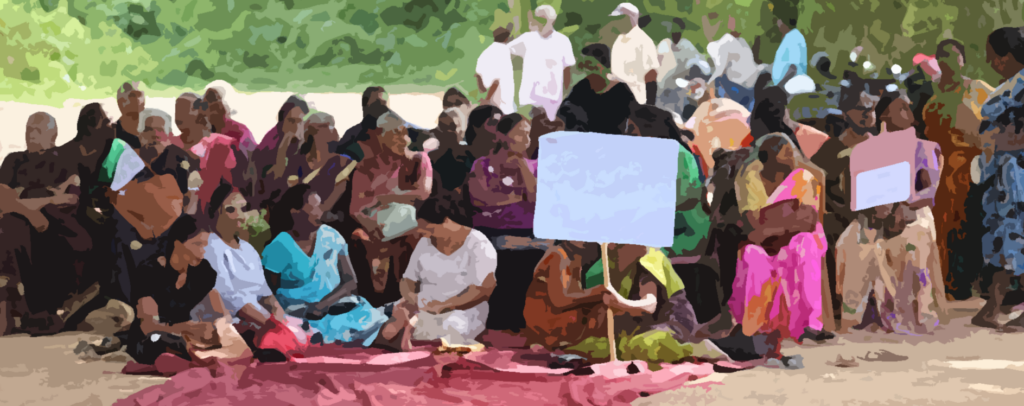
In June, landowners launched sustained protests at Myliddy junction, displaying property deeds and demanding the release of over 2,400 acres still under military control. The protests drew support from MPs Sivagnanam Shritharan and Shanakiyan Rasamanickam, Northern Provincial Council Speaker C.V.K. Sivagnanam, and Valikamam North Pradeshiya Sabha Chair Somasundaram Sugirthan.
Between February and March 2024, the government returned 343.73 acres across several ceremonies, yet this represents a fraction of the land still occupied. The military retains control over more than 2,700 acres, and thousands of families remain unable to return to ancestral lands repurposed for commercial and agricultural use without consent.
Military Expansion and New Developments
In October 2025, the Illankai Tamil Arasu Kachchi announced plans to pursue legal action over the construction of an unauthorised military hospital on privately owned land in Vasavilan. The site lies just outside the designated HSZ boundary, effectively expanding military presence under a new justification. The property belongs to a local Tamil family whose land was seized during the conflict.
Separately, the Valikamam North Pradeshiya Sabha unanimously rejected a Navy request to acquire two acres in Keerimalai for a radar system, despite claims it would assist in combating narcotics trafficking.
These developments reflect a broader pattern wherein the military has entrenched itself within civilian life, serving multiple purposes: maintaining a securitised presence in Tamil-majority areas, facilitating demographic change, and generating revenue through commercial activities on occupied lands.
Administrative Measures and Political Responses
In March 2025, authorities issued Gazette Notification No. 2430, stating lands in Jaffna, Kilinochchi, Mannar, and Mullaitivu would be claimed as state land if owners failed to submit claims by 28 June. Following protests from Tamil politicians, the government revoked the gazette in May. M.A. Sumanthiran filed a fundamental rights application in the Supreme Court, challenging what the Centre for Policy Alternatives described as the most recent attempt to dispossess people through legal and policy initiatives.
During President Anura Kumara Dissanayake’s September visit to inaugurate the Myliddy Harbour Project, Tamil landowners staged a peaceful protest. Police dispersed demonstrators, with reports of assaults on elderly women and intimidation of journalists.
The president acknowledged that civilian lands were seized during the conflict, stating the government would resolve issues and allow people to settle freely. However, Tamil National Alliance Parliamentary Group Leader Sivagnanam Sritharan questioned what actions had been taken, particularly given that the new government had been in power for nearly a year.
The arbitrary nature of state intervention through various government departments—including Archaeology, Urban Development Authority, and Forest Conservation—has sparked fear within communities regarding their ability to continue living on their lands. The Centre for Policy Alternatives noted that such administrative processes demonstrate continued use of law to appropriate lands against the background of successive governments failing to fully implement the Thirteenth Amendment to the Constitution, which provides for limited devolution of land powers to provinces.
In February 2026, Fisheries Minister Ramaligam Chandrasekar announced that selected privately owned lands in Valikamam North would be returned to civilian owners ahead of the Sinhala and Tamil New Year in April. This initiative, overseen by the Ministry of Defence as directed by President Dissanayake, comes nearly seventeen years after the end of the armed conflict. Though the pledge appears promising, large swathes of civilian land across the region remain under military control. Local representatives have raised concerns, highlighting that even in areas that have been partially reopened, security forces continue to occupy or commercially exploit the land. For Tamil residents who have witnessed successive governments make and defer similar promises in the past, this announcement is met with measured caution rather than relief.
Broader Implications
The situation in Valikamam North exemplifies challenges across the Northern and Eastern provinces, where land has remained a catalyst for conflict for decades. Research indicates that state structures have often been employed to perpetuate land conflicts rather than resolve them, undermining efforts toward social cohesion and reconciliation.
The cases demonstrate how various trends intersect: ethnonationalist narratives, government authority intervention, military expansion, and profit-making development projects. The appropriation of land under various pretexts, such as national security, heritage preservation, and urban development, has displaced communities, disrupted livelihoods, and deepened ethnic and religious divisions.
For residents of Valikamam North, the gap between official promises and lived reality remains substantial, with no clear timeline for the full release of occupied lands.
References
https://www.virakesari.lk/article/224731
https://www.tamilguardian.com/content/valikamam-north-land-protest-enters-fourth-day-deeds-displayed
https://www.tamilguardian.com/content/after-decades-military-control-palaly-temple-reopens-devotees
https://www.tamilguardian.com/content/valikamam-north-residents-petition-governor-land-release
https://www.cpalanka.org/land-appropriation-continues-to-threaten-northern-and-eastern-communities/
https://www.virakesari.lk/article/213402
Last updated – March 2026