
The Transformation of Kuchchaveli: 32 Buddhist Temples Spark Contestation
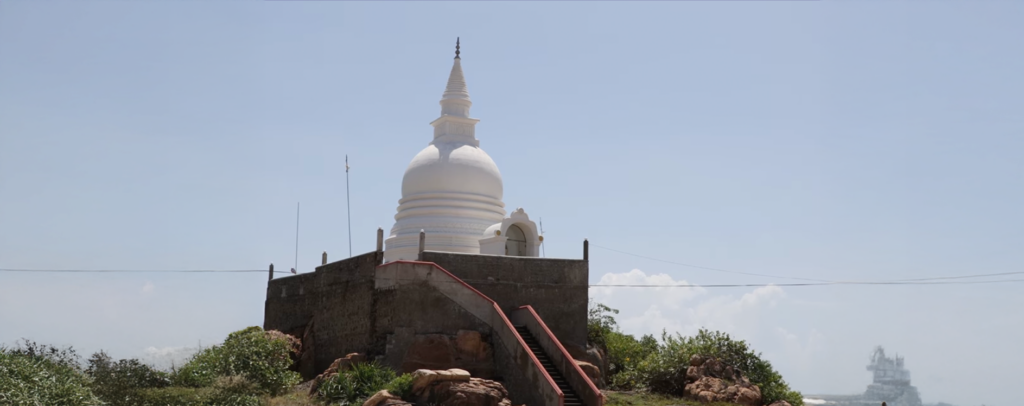
Over 2,500 acres of predominantly private land in Trincomalee’s Kuchchaveli Divisional Secretariat have become the focal point of escalating land disputes, as construction proceeds on 32 Buddhist temples across a historically Tamil-majority area.
The temple constructions, many now officially registered under the Kuchchaveli Divisional Secretariat, represent a continuation of patterns documented throughout Sri Lanka’s Northern and Eastern provinces. Kuchchaveli Division, one of eleven administrative divisions in Trincomalee District, has witnessed systematic land acquisitions through various legal mechanisms, including declarations under the Antiquities Act, the Town and Country Planning Ordinance, and designations as “Pooja Boomi” or “Pooja Grant” lands.
Several temples exemplify the scope of these acquisitions. The Bambarakala Purana Raja Maha Viharaya, registered in 2013, encompasses 102.408 hectares. The Masangawewa Pinkaththugama Raja Maha Viharaya controls 152.679 hectares, whilst the Yan Oya Purana Raja Maha Viharaya occupies 147.318 hectares. The Mega Wewa temple alone has been allocated 1,562.02 hectares, though construction has been halted due to the extent of private land included within its boundaries.
The acquisition processes have frequently circumvented standard procedures. In multiple instances, the Department of Archaeology has declared sites as archaeological reserves under Section 16 of the Antiquities Act, followed by Gazette notifications designating areas as “sacred sites” through the National Physical Planning Department. The Asirikantha Purana Raja Maha Viharaya in Pulmoddai, for instance, was declared a “sacred area” in March 2022, incorporating 109.9858 hectares of land.
Local communities have mounted sustained resistance. In the case of Girihandu Seya Neeththu Papana Raja Maha Viharaya in Thiriyai, attempts by the Department of Survey to map an expanded 500-acre archaeological reserve were abandoned following protests from residents whose farmland would have been affected. At Pathmaraja Papatha Vanasenagana, Tamil farmers have filed cases in Trincomalee Magistrate’s Court challenging land seizures after a monk obtained 370 acres and erected barriers on historically Tamil-held lands.
The intersectionality of state mechanisms proves notable. Whilst the Department of Archaeology provides the initial legal framework through archaeological designations, subsequent interventions by the National Physical Planning Department, Divisional Secretariats, and land commissioners complete the acquisition process. In several cases, including the Cheiththiyagiri Purana Raja Maha Viharaya, the Divisional Secretary has sought consultation from the Attorney General regarding land that includes substantial private holdings.
The pattern extends beyond temple construction. At Thennamaravadi, approximately 358 acres from Panikkanvayal to Thennamaravadi village have been appropriated by the Department of Archaeology, affecting Tamil farming communities whose families have cultivated the land for generations. Legal challenges filed in the High Court of the Eastern Province by multiple petitioners have been dismissed, whilst restrictions imposed by the Department of Forest Conservation have further constrained agricultural activity.
The February 2024 designation of eleven temples, including Muhudu Maha Viharaya and Yan Oya Raja Maha Viharaya, as “sacred sites” through the National Physical Planning Department signals the continuation of these acquisitions. Documents were submitted directly to the Presidential Secretariat, bypassing provincial administrative structures. Similarly, tensions escalated in November 2025 when monks began constructing a structure on a 40-perch coastal plot in Trincomalee town, one day before the Coastal Conservation Department was scheduled to demolish an unauthorised café on the site. When police and conservation officers arrived, monks refused to halt construction. A Buddha statue was placed on the land, prompting intervention by Tamil politicians and activists. Following orders from the Minister of Public Security, police removed the statue, leading to physical confrontations in which monks assaulted officers. No arrests were made. The incident underscored the challenges authorities face when enforcing coastal conservation laws on land claimed for religious purposes.
The situation has intensified in 2025. In January, residents of Verugal protested against the Department of Archaeology’s designation of the Verugal-Vattavan area as a “1 KM Vattavan Archaeological Zone,” expressing fears of Sinhalisation, displacement, and increased militarisation in an area that already hosts at least seven military installations. By March, ITAK MP Shanmugam Kugathasan reported during the budget debate that Sinhala Buddhist monks had seized control of 3,820 acres across the Trincomalee district under “Pooja Land” designations, rendering previously cultivated farmland unusable and threatening Tamil farmers’ livelihoods.
In May 2025, a public meeting in Kuchchaveli addressed concerns over “Pooja Bhoomi” land designations, with Tamil residents voicing anxieties about the future of disputed lands. Days later, MP Kugathasan called for an immediate halt to Forest Department land seizures, noting that over 236,000 acres across multiple divisions have been affected by claims from the Forest and Wildlife Departments, the Department of Archaeology, and Buddhist monks under pretexts of conservation, archaeology, or religious use, causing substantial losses in paddy production, livestock, and livelihoods.
In September 2025, a land dispute arose over the paddy field Vairavar Kandal Aruppar in the Yan Oya area of Pulmottai, with Kuchchaveli Police instructing both parties not to enter the land pending resolution through land authorities.
These developments occur within the broader context of post-war land appropriation in the Northern and Eastern provinces, where demographic compositions have historically differed markedly from the nation’s overall ethnic distribution. The systematic nature of the acquisitions, the legal mechanisms employed, and the scale of land affected have generated concerns amongst affected communities and observers regarding long-term implications for land tenure, demographic patterns, and inter-communal relations in the region.
References
https://www.cpalanka.org/the-intersectional-trends-of-land-conflicts-in-sri-lanka/
https://www.tamilguardian.com/content/tamils-trincomalee-protest-against-sinhalisation
https://www.ahrc.lk/index.php/component/content/article/trincomalee-land-recovery-network-discussion?catid=27&Itemid=101&iccaldate=2031-06-1
https://www.tamilguardian.com/content/buddhist-monks-taken-over-lands-trincomalee-name-pooja-lands
https://www.tamilguardian.com/content/kuchchaveli-land-issue-sparks-official-meeting-local-residents
https://www.tamilguardian.com/content/tamil-mp-urges-immediate-halt-forest-departments-land-grabs-citing-massive-agricultural
https://www.virakesari.lk/article/210824
https://www.facebook.com/share/v/1BLtLAcGpq/
https://www.examiner.media/authorities-try-to-demolish-unauthorised-trinco-cafe-monks-livid-at-police-upholding-the-law/
https://www.adaderana.lk/news.php?nid=114825
Last updated – March 2026