
The Navy Eleven
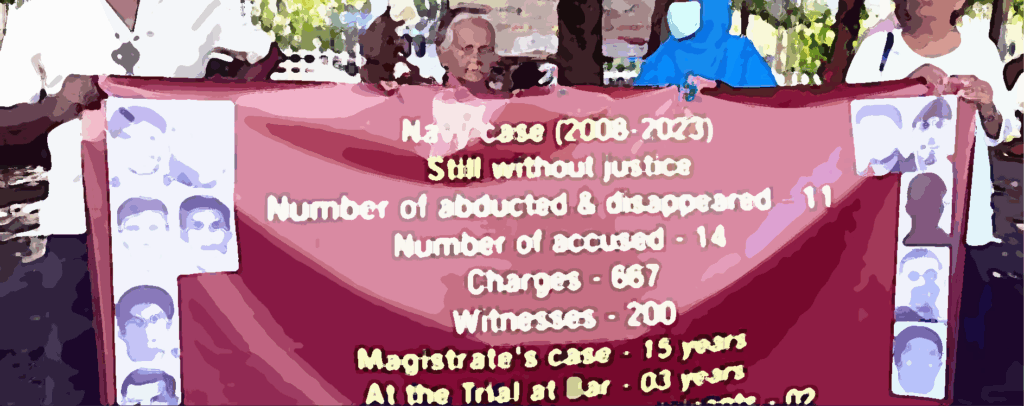
Between August 2008 and February 2009, eleven men were abducted on the streets of Colombo. Six were Tamil, three were Muslim, and two were Sinhalese. Their ages ranged from 17 to 50. Among them were students celebrating university admission, a father and son, and several naval informers. Nearly two decades later, despite overwhelming evidence of state involvement, no one has been held accountable.
The Disappearances
On 17 September 2008, five friends—Rajiv Naganathan (21), Pradeep Vishwanathan (18), Thilakeswaran Ramalingam (17), Mohamed Sajid (21), and Jamaldeen Dilan—disappeared in Dehiwala while on their way to meet a man later revealed to be a naval informant.
This case is unique because for nearly two years after his abduction, Rajiv kept in touch with his family through phone calls made from mobile phones belonging to sympathetic naval personnel. He told his father they were being held at “Pittu Bambuwa” near Chaitya Road in Colombo, and later at the “Gun Site,” underground prison cells at the Trincomalee Naval Command. After May 2011, the calls stopped.
The cases of other victims followed similar patterns. Between August 2008 and February 2009, the eleven men were abducted by naval intelligence personnel and initially held at naval headquarters in Colombo before being transferred to Trincomalee. Families received ransom demands, which, though paid by some, did not result in their loved ones being freed
The Underground Torture Complex
The UN Working Group on Enforced or Involuntary Disappearances (WGEID) visited the site in November 2015. They concluded that systematic torture had taken place in the underground cells, which could not have operated “unnoticed” by other officials.
Gun Site consists of three former colonial artillery points in the jungle-covered hills of the Trincomalee naval base. The munitions bunkers were used by Naval Intelligence to detain and interrogate prisoners. The WGEID discovered two underground complexes containing eleven cells, with evidence suggesting the facility operated from at least 2006 to 2012.
Survivors described horrific conditions: cells with no natural light, detainees kept in their underwear, sleeping on bare cement floors, and allowed out only twice in 24 hours for toilet breaks. The CID’s former chief investigating officer told the court that the conditions themselves constituted torture.
Significant Dates from the Case
The case began in 2009 with a complaint that had nothing to do with justice. Then-Navy Commander Admiral Wasantha Karannagoda filed a complaint against his aide-de-camp, Lt. Commander Sampath Munasinghe, after identity cards of four of the eleven disappeared men were found in Munasinghe’s quarters during a search—allegedly triggered by suspicions of an affair with Karannagoda’s wife.
What followed was a decade of obstruction:
- 2009-2015 – The CID didn’t request a search warrant for Gun Site until 2015—six years after the investigation began. The WGEID noted that if a proper investigation had been launched in 2009, lives could have been saved.
- 2017: Key suspect Lt. Commander Chandana Prasad Hettiarachchi disappeared. He was allegedly provided Rs. 500,000 and was smuggled out of the country on instructions from Admiral Ravindra Wijegunaratne, then the country’s highest-ranking military official as Chief of Defence Staff.
- 2018: Wijegunaratne was arrested for aiding Hettiarachchi’s escape and attempting to abduct a key witness at gunpoint. He was released on bail days later.
- 2019: Despite the Attorney General preparing indictments with 667 counts against 14 suspects, including Admiral Karannagoda, the Supreme Court prevented his arrest. By August 2019, the same president who ordered this protection promoted Karannagoda to Admiral of the Fleet, the Navy’s highest rank.
- 2021: The Attorney General withdrew indictments against Karannagoda. The Colombo High Court initially rejected this request as procedurally irregular, but the decision stood after appeal.
- 2025: The Supreme Court has agreed to hear an appeal from the families of the 11 victims who allegedly went missing after being abducted. They are challenging the Attorney General’s decision to remove former Navy Commander Admiral Wasantha Karannagoda as a suspect in the case. The court’s hearing is set for 30 January 2026, after a thorough review of the situation. However, as of March 2026, there is no publicly available information regarding the hearing.
The Navy Eleven case reveals a systematic pattern: illegal detention sites operating for years in high-security naval bases, torture and enforced disappearances on an industrial scale, and senior commanders either directly ordering or deliberately ignoring these crimes. The UN investigation concluded that “a large swathe of the naval high command was complicit in the violations or directly responsible for them.”
In 2023, the U.S. government imposed a travel ban on Admiral Karannagoda, citing his involvement in serious human rights violations. Yet in Sri Lanka, the legal system continues to shield him and others from accountability. The message from Sri Lanka’s state apparatus remains unchanged: if you’re powerful enough, you’re untouchable.
For those interested in exploring the case further, detailed reports and primary sources are linked below.
References
https://www.cpalanka.org/elusive-justice-and-emblematic-cases-in-sri-lanka/
https://sangam.org/wp-content/uploads/2024/10/ITJP_navy_reportfinal-2-SINGLES.pdf
https://lankanewsweb.net/archives/71449/political-delays-stall-justice-in-sri-lankas-navy-11-case/
https://www.dailymirror.lk/news-features/Ex-Navy-chiefs-writ-petition-fixed-for-trial-in-September/131-285901 https://www.dailymirror.lk/latest-news/Two-SC-judges-decline-to-hear-appeal-relating-to-Karannagoda/342-305525
https://www.themorning.lk/articles/gJq9cfCwzR7KKnzvCCJZ
Last updated – March 2026