A repeat of the Sinhala-Buddhistisation agenda in Trincomalee
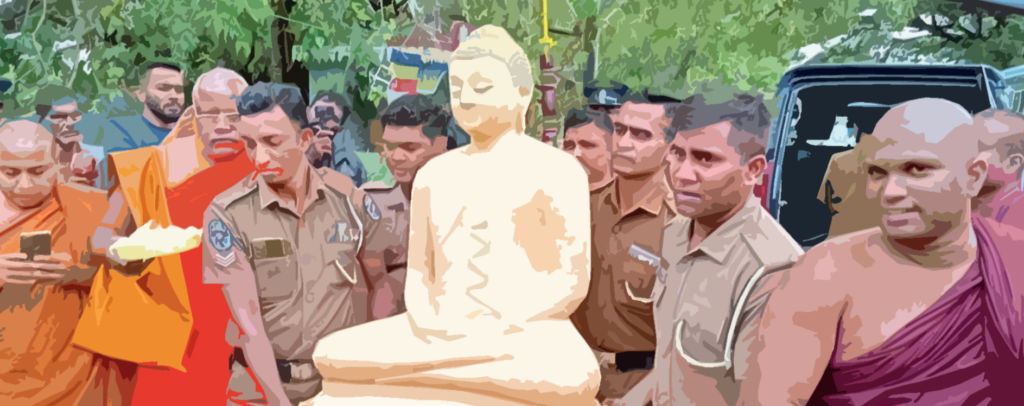
Trincomalee, a hotbed for ethnonationalist sentiment, saw a repeat of the Sinhala-Buddhistisation agenda, on the 16th of November 2025.
In July 2023, chief incumbent of the Sri Sambuddha Jayanthi Bodhiraja Viharaya in Trincomalee had been granted a temporary licence for a small welfare shop measuring approximately 127 square feet, valid only until mid-2024. However, the permit had been extensively misused to transform the site into a large-scale commercial operation. As a result, on the 4th of November 2025, the Coast Conservation Department cancelled the permit, ordered its removal, and warned that failure to comply would result in demolition. However, instead of demolishing the said structure the monk installed a buddha statue the day before the CCD had planned to demolish the cafe. It led to a tense situation between the monks and the Trincomalee police when the unauthorized buddha statue was removed from the site and taken to the Trincomalee Police Station.
Minister of Public Security Ananda Wijepala spoke in parliament the following morning, claiming the statue was removed solely due to concerns about potential vandalism. He added that it has been returned to its original location and will be provided with police protection. The chief incumbent of the temple, Venerable Trincomalee Kalyanawansa Wansa Tissa Thero has filed a writ petition in the Court of Appeal requesting the issuance of an order to prevent the demolition. On the 20th of February 2026, the Court of Appeal ordered the petition to be called on the 28th of April 2026 to allow for consideration of matters regarding a potential settlement of the case.
This is not a standalone incident; it is part and parcel of the ethnonationalist agenda in the North and East. Hostilities and divisions are further intensified by non-state actors, particularly by the growing involvement of Buddhist clergy as seen in the recent incident. November 16th highlights how Buddhism is used as a shield to divert attention from actions that perpetrators would otherwise be held accountable for. As noted in CPA’s report, The Intersectional Trends of Land Conflicts in Sri Lanka there are multiple instances where the Buddhist clergy have entered lands belonging to minority religious communities in the North and East, and have uprooted, renamed, and claimed land as ‘sacred areas’ or ‘Buddhist sites.’
The government’s handling of the recent incident in Trincolmalee risks creating new conflict triggers and calls into question their commitment towards addressing the root causes of the civil war. In the Trincomalee district, particularly in the Kuchchaveli Division 32 Buddhist temples have been constructed in areas with a majority of Tamil and Muslim population. In such a context, the handling of the recent incident deters the reconciliation process. It brings to light the government’s lack of a clear position on the land conflicts in the North and East. With the NPP now more than a year into government, we are forced to question the legitimacy of their promises and whether genuine reconciliation efforts are in place.
References
https://x.com/chami9539/status/1991349254972203367?s=20
https://www.adaderana.lk/news.php?nid=118686
Last updated – March 2026