Understanding Sri Lanka’s Proposed Terrorism Bill: What You Need to Know
Sri Lanka is considering new counter-terrorism legislation that would replace the Prevention of Terrorism Act (PTA), a law that has been in force for nearly half a century. The newly drafted Protection of the State from Terrorism Bill was published in December 2025, inviting public comments within a month. However, to understand what this new bill means, it’s worth looking at why the PTA has been so problematic.
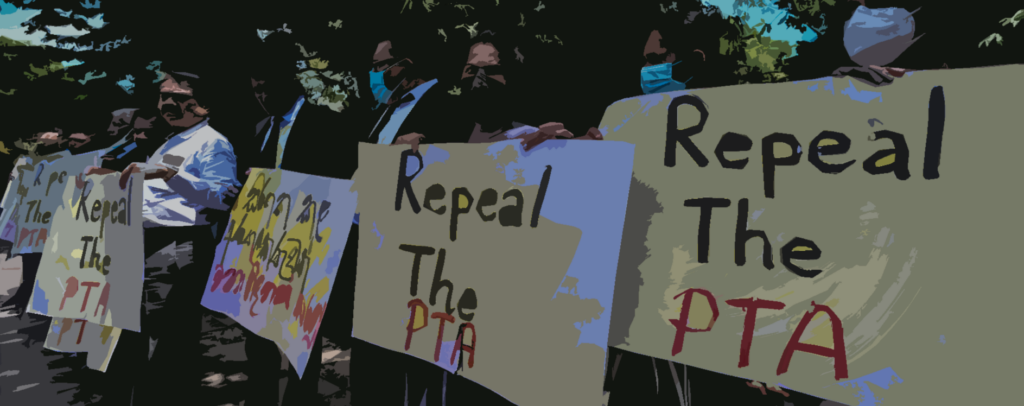
The Legacy of the Prevention of Terrorism Act
The PTA was enacted in 1978 as a temporary measure, intended to last just three years. By 1982, it had been made permanent. From the outset, the law introduced powers that did not exist in ordinary criminal law, and these provisions have been subject to serious human rights concerns throughout its operation.
One provision in particular—section 2(1)(h)—has been used to suppress dissent and target journalists, human rights activists, and politicians. The PTA allowed suspects to be detained for extended periods without being produced before a judicial officer, and it permitted confessions to be admitted as evidence. These features created a system that encouraged the use of torture to obtain confessions, with limited need for other evidence. The Human Rights Commission of Sri Lanka has documented the widespread use of torture against those arrested under the PTA.
The law was passed hurriedly through Parliament in1978. Because the government of the day held a special majority, it was able to enact the PTA despite the Supreme Court identifying provisions that violated fundamental rights guaranteed by the Constitution. In its 2000 decision in Weerawansa v Attorney General, the Supreme Court explained that it had not been required to assess whether the PTA’s restrictions on constitutional rights were reasonable, because the government had informed the Court that it would pass the bill with a two-thirds majority regardless.
The legislative process itself was rushed. The PTA was introduced as an urgent bill, which gave the Supreme Court just 72 hours to conduct a hearing, review the bill, and communicate its decision to Parliament. The bill was not made public before going to court, and only the Attorney General was heard by the Supreme Court. Originally, the PTA contained a sunset clause that would have limited its operation to three years. But before that period expired, the government removed the clause, making the temporary law permanent in 1982.
Why Reform Efforts Matter
The present government, like the one that enacted the PTA in 1978, has a special majority (2/3rd majority) in Parliament. This means it can repeal the PTA without procedural obstacles. The NPP government, in their campaign promises, stated that all oppressive acts, including the PTA, would be abolished. Therefore, given their parliamentary strength, there is an expectation that any replacement law should not simply be better than the PTA; it should fully comply with the Constitution and international human rights standards.
Over the past decade, there have been three attempts to reform or replace the PTA.
- First attempt – In 2018, the Ministry of Foreign Affairs, under the leadership of the late Mangala Samaraweer, published the Counter Terrorism Bill (CBL). The Bill faced significant criticism for not adhering to international human rights standards and was challenged in the Supreme Court, which found some provisions unconstitutional. Ultimately, the Bill was not passed.
- 2nd attempt – This attempt took the form of amendments to the PTA in 2022. The amendments were generally seen as inadequate for addressing the real experiences of those impacted by the PTA.
- 3rd attempt – In 2023/2024, the government attempted to replace the PTA through the Anti-Terrorism Bill (ATB). A draft of the Bill was published in early 2023 but faced widespread criticism, leading to its withdrawal. The ATB faced legal challenges before the Supreme Court and was ultimately never enacted.
These efforts reflect both sustained international pressure and growing public concern about the law. The newly proposed Protection of the State from Terrorism Bill resembles earlier drafts from 2018 and 2023/2024 in structure, with some limited improvements. Many of the concerns raised regarding the earlier drafts persist.
What Does the New Bill Define as Terrorism?
According to clause 3 of the proposed bill, an act of terrorism is defined as intentionally or knowingly committing any act for certain specified purposes that leads to certain specified consequences. When considering the combinations of these definitions, the bill creates a broad interpretation. For example, it could include behaviours that are already punishable under other laws, but may not necessarily be classified as terrorism.
Additionally, Clause 3(4) specifies that simply engaging in protest, advocacy, dissent, or industrial action does not, on its own, constitute terrorism. However, this exclusion is somewhat vague and fails to offer clear guidance on when a protest could still be classified as terrorism. While some of the language seems to address criticisms of previous initiatives, the definition remains problematic.
Other Provisions That Raise Concerns
The new bill introduces several related offences, all connected to the definition of terrorism outlined in clause 3. Because this definition is quite broad, the related offences also have a wide-ranging impact.
Media and civil society organisations have raised concerns about provisions that might limit freedom of expression and press freedom. These provisions include clauses that criminalise the collection, recording, or publication of information regarding the armed forces, police, or investigative methods if that information could be deemed useful to terrorism. Under the pretext of counter-terrorism efforts, these provisions could potentially be used to silence journalism.
Executive Detention
The Constitution mandates that detention must be based on a judicial order. However, the Prevention of Terrorism Act (PTA) introduces an exception by allowing the Minister of Defence to issue detention orders. This provision has become one of the most contentious aspects of the PTA, effectively normalising such actions.
The proposed bill also includes provisions for detention orders. Under clause 29, the Minister of Defence can issue an order if they are satisfied that a person is connected to terrorism and that detention is necessary for specific purposes, such as preventing acts of terrorism or gathering evidence. While the new bill outlines certain circumstances that must be met, these criteria remain quite broad.
According to the new bill, executive detention can last for up to one year. When this is combined with the period of remand, an individual could be deprived of their liberty for a total of two full years before any indictment is even issued. This means that a person could spend two years in detention before it is determined whether there is sufficient basis to proceed with a case against them.
Confessions and Torture
The proposed bill outlines a procedure for admitting confessions made to a Magistrate as evidence. This process includes specific safeguards that differ from the current practice: a judicial medical officer is required to examine the suspect, and the Magistrate must ensure that the confession is given voluntarily. However, it is the responsibility of a police officer to initiate this process by presenting the suspect to the Magistrate for the recording of a confession that may later be used against the individual.
Given the documented history of coerced confessions under the PTA and the fact that the proposed bill allows for prolonged detention even after a statement has been recorded, there remains a risk of coercion that may not leave any physical evidence.
The proposed bill introduces certain protective measures aimed at preventing torture. For instance, a Magistrate is required to visit detention facilities at least once a month to interview detainees. Additionally, suspects must be brought before a Magistrate every fourteen days during a detention order, and the Human Rights Commission is granted access to these facilities.
Despite these measures, they exist within a framework that still permits prolonged detention, allows confessions under specific circumstances, and enables delays of up to three days before a suspect is presented before a Magistrate following their arrest. In a context where torture has been prevalent, these aspects undermine the effectiveness of the safeguards in place.
Military Involvement in Law Enforcement
Clause 19 of the proposed bill permits the armed forces to perform functions that are typically reserved for the police. When the armed forces or the coast guard make an arrest, they are required to present the suspect to the officer-in-charge at the nearest police station within twenty-four hours. In contrast, a police officer must present a suspect “forthwith,” raising questions about the lack of similar urgency in arrests by the armed forces. Additionally, clause 20 empowers members of the armed forces to stop and search individuals, representing a notable shift from standard criminal procedures. Military personnel are permitted to enter private premises, carry out searches, and seize documents, items, or other materials without a warrant. While the exercise of this authority requires reasonable suspicion that an offence under the bill is being committed, the broad range of offences outlined in the legislation undermines this safeguard in practice. This ongoing military involvement in routine law enforcement raises concerns about civilian oversight.
Presidential Powers
The proposed bill grants the President extensive powers to designate organisations as proscribed under Clause 63. If the President believes that an organisation is involved in conduct that violates the Act or is acting in a way that is harmful to national security, he has the authority to declare it proscribed. Following this declaration, the President can prohibit various activities, including the publication of materials that promote the organisation’s objectives.
Clause 6 criminalises a broad range of activities associated with a proscribed organisation. This includes participating in its activities, harbouring its members, or advocating for its cause. When these provisions are combined, they create a mechanism that could potentially be used to suppress dissent, especially due to the vague wording regarding conduct that is considered prejudicial to national security.
Additionally, the new bill empowers the President to impose curfew orders under Clause 65. These powers are broader than those provided under the Public Security Ordinance. Curfews can be applied to all or part of Sri Lanka, including territorial waters and airspace, and may be enacted for the protection of national security, public security, public order, or public safety.
Although each curfew is limited to twenty-four hours and requires a minimum interval between consecutive curfews, there is no overall limit on the total duration of these curfews. This means that curfews can be repeatedly extended for long periods.
The Need for More Time and Discussion
The proposed bill was published during a time when Sri Lanka was grappling with the aftermath of Cyclone Ditwah. This situation has hindered meaningful public engagement, and the two-month comment period has been criticised as insufficient for promoting inclusive and transparent law reform.
The criteria for assessing this new bill should not only focus on whether it improves upon the PTA but also on its compliance with fundamental rights guaranteed under the Constitution and Sri Lanka’s international human rights obligations. The PTA was never constitutional, and its drafters never claimed it was. It was enacted with a special majority that allowed it to bypass constitutional safeguards.
A thorough review of the proposed bill requires more time for careful analysis and public consultation. What is evident is that while the new bill makes some changes from the PTA, it retains features that risk perpetuating the very problems that have made the PTA problematic for nearly half a century.
References
https://www.cpalanka.org/a-brief-history-of-the-prevention-of-terrorism-act-questions-and-answers/
https://www.cpalanka.org/analysis-of-the-significant-concerns-on-the-protection-of-the-state-from-terrorism-bill-questions-and-answers/
Last updated – March 2026